
Nonstructural Risk Assessment
FEMA E-74 Assessments
Risk assessments for existing facilities to reduce nonstructural seismic damage. We inventory hazards, apply the FEMA E-74 mitigation hierarchy, and deliver a prioritized, owner-ready plan aligned with ASCE 7-22 and HCAI/OSHPD requirements.
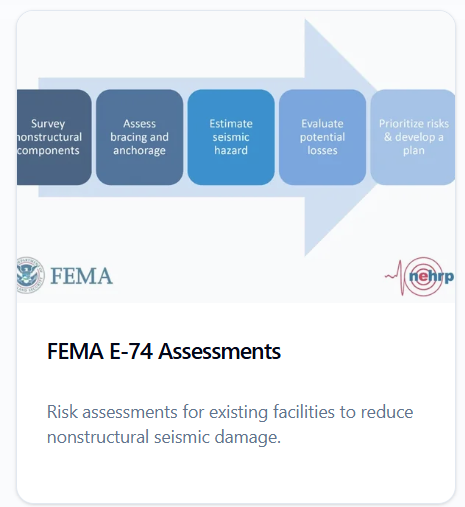
The FEMA E-74 Assessment Process
Five phases that take a facility from initial walk-through to a prioritized nonstructural mitigation plan.
Walk-through inventory of architectural, mechanical, electrical, plumbing, and contents items. Each hazard is photographed and tagged with location, weight, and existing restraint per the FEMA E-74 building-type chapter.
Evaluate existing supports against ASCE 7-22 §13 demand. Identify deficient anchorage, missing sway bracing, vulnerable suspended ceilings, and unrestrained equipment.
Establish design forces using site SDS, Risk Category, importance factor Ip, and component coefficients. Map demands back to each inventoried item.
Quantify life-safety, downtime, and property-loss consequences for each hazard. Distinguish code-required mitigation from owner-driven mitigation per E-74 guidance.
Apply the E-74 mitigation hierarchy — eliminate, restrain, or protect — and produce a prioritized package with budget tiers, pre-engineered details, and code references.
What you receive
Each FEMA E-74 engagement produces an owner-ready report and the engineering deliverables needed to act on it.
- Hazard inventory with photographs, locations, weights, and existing restraints
- ASCE 7-22 §13 design force summary per component
- Mitigation recommendations ranked by life-safety, downtime, and cost
- Pre-engineered restraint details and bill of materials for typical components
- PE / SE stamped calculations for engineered anchors, braces, and supports
- Owner-ready report with code references (FEMA E-74, ASCE 7-22, ASCE 41, CBC, HCAI/OSHPD)
Who it’s for
FEMA E-74 assessments are most valuable for owners of existing facilities where downtime, occupant safety, or critical operations are at stake.
Existing acute-care buildings with legacy nonstructural components that fall outside current OSP/OPM preapprovals.
Owners targeting post-earthquake function for IT, generators, UPS, batteries, and cooling systems.
Risk Category III & IV facilities upgrading bracing, anchorage, and contents restraints in existing structures.
Process equipment, racks, and distribution systems where downtime drives the business case for mitigation.
Related work
FEMA E-74 dovetails with our code-required certification and anchorage design services.
Code-required design forces for nonstructural components — the baseline E-74 builds on.
View the ASCE 7-22 Chapter 13 guideOSP/OPM preapproval for hospital equipment — the certification path that pairs with E-74 mitigation work.
Read the OSHPD & IBC certification overviewLong-form guide on the mitigation hierarchy, restraints, and how E-74 relates to ASCE 7-22 and OSHPD.
Read the articleFrequently asked questions
Plan your nonstructural mitigation program
Talk to a board-certified engineer about scoping a FEMA E-74 assessment for your facility.
Related guides in this topic hub
Continue through the connected code, certification, and design references.