
FEA & CFD Services
Finite Element Analysis Services
Structural, mechanical, and seismic finite element analysis (FEA) plus computational fluid dynamics (CFD) consulting and simulation services. Linear and nonlinear, static and dynamic — modal, response spectrum, and time-history analysis of equipment, enclosures, non-building structures, and buildings. ANSYS, Abaqus, LS-DYNA, RISA-3D, STAAD.Pro, SAP2000, ETABS, Fluent, and STAR-CCM+ — PE/SE stamped reports per ASCE 7-22, AISC 360, ACI 318, and IEEE-693.
- ASCE 7-22
- AISC 360-22
- ACI 318-19
- IEEE-693
- ICC-ES AC156
- ASCE 41-17
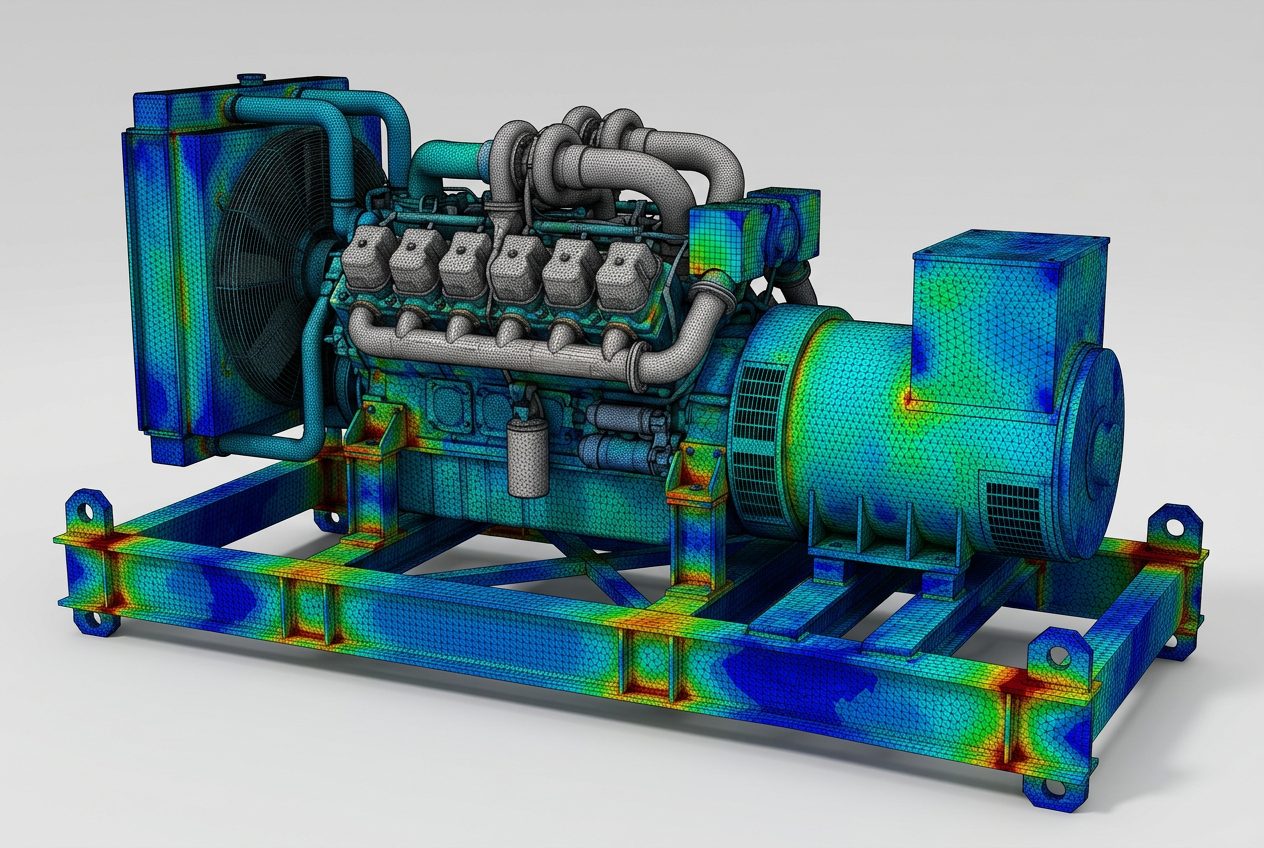
FEA & CFD disciplines
One stamped engineering team across structural FEA, mechanical FEA, seismic FEA, and CFD — so wind, thermal, and structural load paths stay coordinated end-to-end.
Buildings, non-building structures, equipment skids, pipe racks, and enclosures per ASCE 7-22, AISC 360, ACI 318. Linear and nonlinear static, modal, response spectrum, and time-history analysis with PE/SE stamped reports.
Stress, fatigue, contact, and thermal-mechanical analysis of weldments, pressure vessels, brackets, and components. ASME BPVC and AWS D1.1 weld checks with mesh-converged results.
ASCE 7-22 §12.9 modal response spectrum, §16 nonlinear time-history, and IEEE-693 qualification. Anchor reactions delivered in ACI 318-19 Ch. 17 format for HCAI/OSHPD and IBC submittals.
CFD consulting and simulation — wind flow, vortex shedding, enclosure thermal/airflow, and ASCE 7-22 §31 wind tunnel procedure. ANSYS Fluent, OpenFOAM, and STAR-CCM+ feeding pressures back into the structural FEA model.
Analysis methods we deliver
Method selection follows ASCE 7-22 Table 12.6-1, §15 (non-building structures), §16 (nonlinear response history), and ICC-ES AC156 §6.2 (rigid vs. flexible classification).
Small-deformation, linear-elastic stress and deflection checks under code-prescribed equivalent lateral loads (ASCE 7-22 §12.8 ELF, wind §27/30, snow §7). Used for sizing, code compliance, and serviceability of equipment frames, skids, supports, and braced structures.
- ASCE 7-22 ELF and wind pressure checks
- AISC 360 / AISI / ACI 318 member capacity
- Stress concentration screening at welds, bolts, and re-entrant corners
Geometric (P-Δ, large displacement), material (von Mises plasticity, concrete cracking), and contact (gap, friction) nonlinearities. Required for buckling-controlled members, anchorage with ductile failure, and ASCE 41 performance-based assessment of existing structures.
- P-Δ and large-deformation effects
- Material plasticity and concrete cracking
- Bolt slip, gap closure, and contact nonlinearity
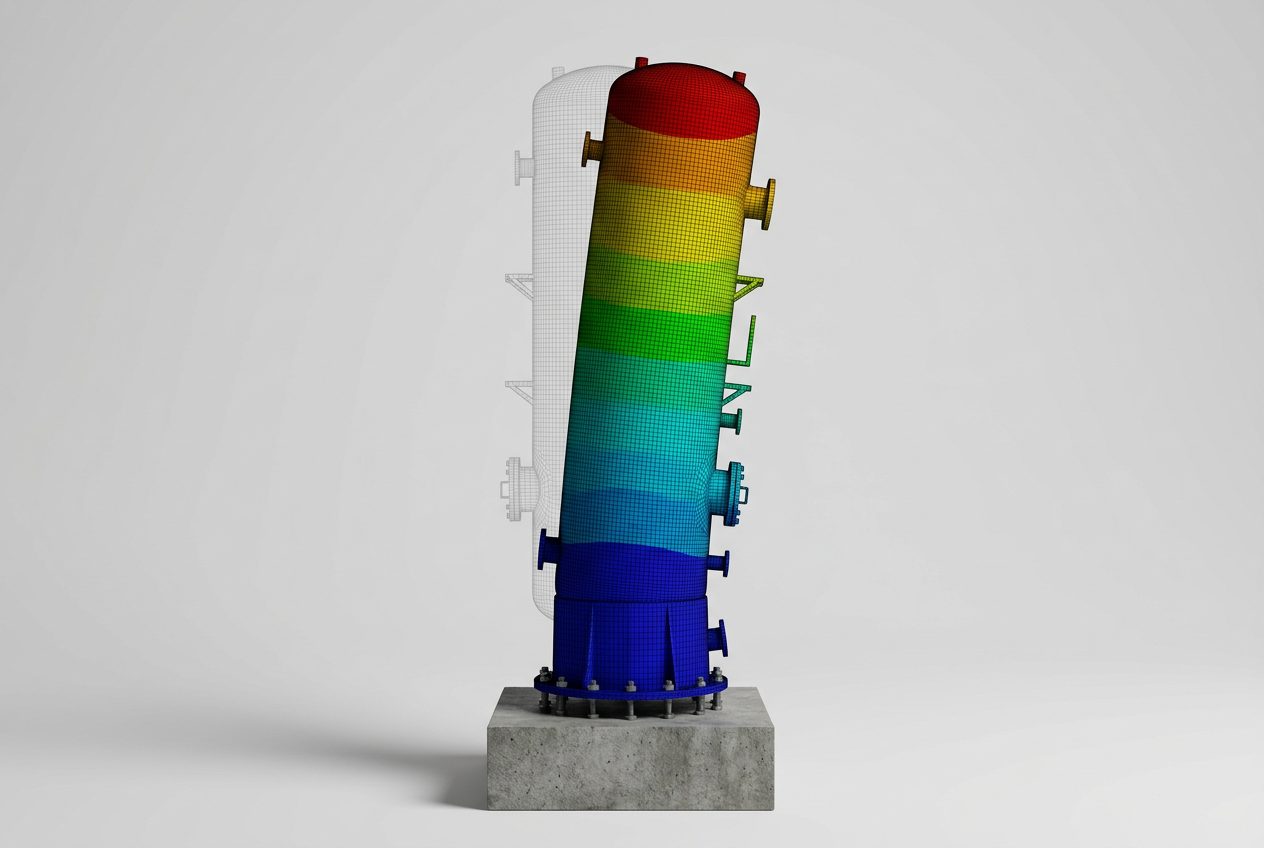
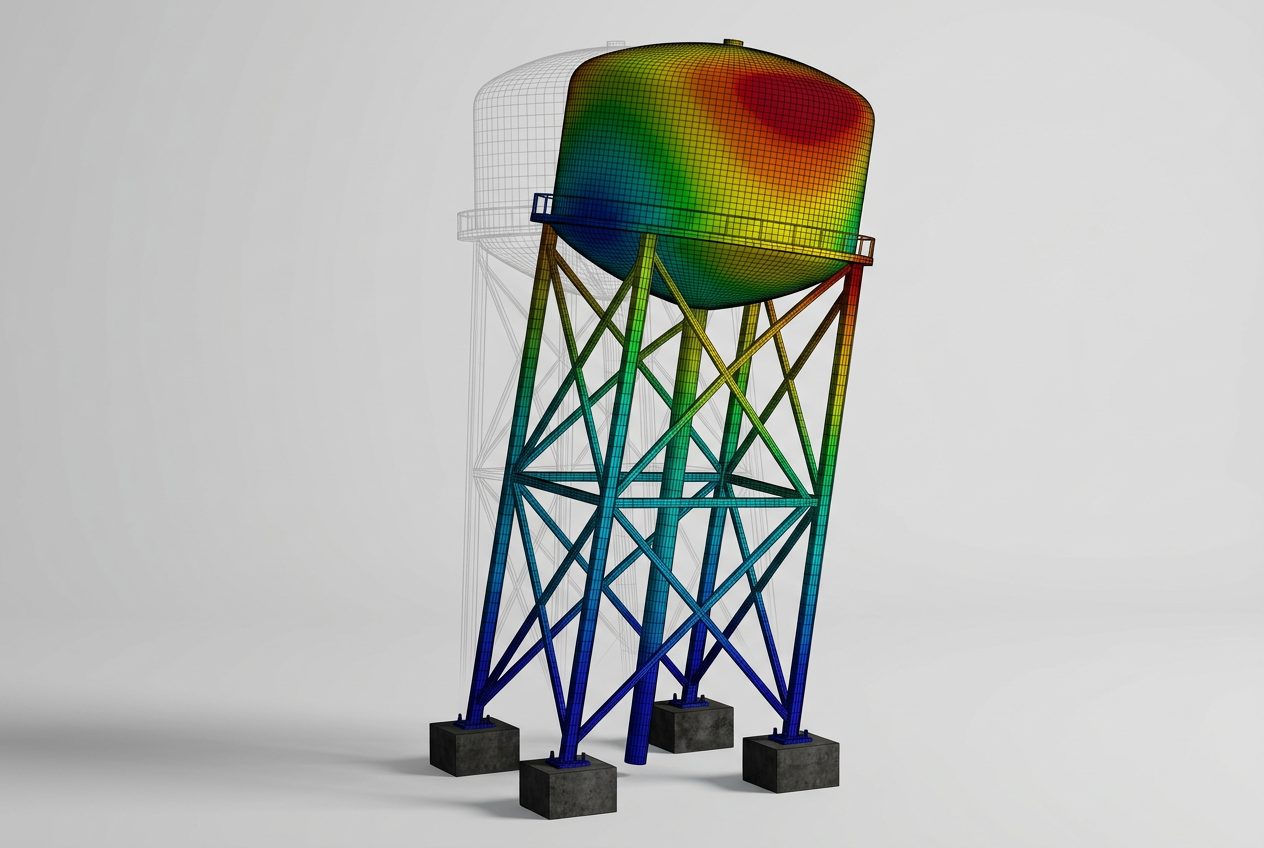
Natural frequencies, mode shapes, and mass participation factors. Required input for ASCE 7-22 §12.9 Modal Response Spectrum Analysis (MRSA) and for confirming the rigid/flexible classification (T < 0.06s) in ICC-ES AC156 §6.2 and ASCE 7 §13.2.6.
- First 30+ modes with ≥ 90% mass participation per ASCE 7-22 §12.9.1.1
- Rigid vs. flexible classification (fn ≥ 16.7 Hz)
- Lanczos / Block-Lanczos eigensolver for large models
ASCE 7-22 §12.9 modal response spectrum analysis using the site design spectrum (Sds, Sd1, TL). Modal responses combined by CQC, with directional combination per §12.9.1.4 and scaled to 100% of the ELF base shear.
- ASCE 7-22 §11.4 site spectrum (Sds, Sd1, TL)
- CQC modal combination, 100% × 30% directional combination
- Base shear scaling to ELF and accidental torsion
Direct integration (Newmark-β, HHT-α) with site-specific spectrum-matched ground motions per ASCE 7-22 §16. Used for non-building structures, base-isolated systems, post-installed anchors with ductile failure, and IEEE-693 high seismic qualification of substation equipment.
- Suite of 11 spectrum-matched 3-component records (ASCE 7-22 §16.2)
- Rayleigh damping calibrated to first two modes (typ. 5%)
- IEEE-693 sine-beat / time-history for substation equipment
ASCE 7-22 directional and envelope procedures for MWFRS and C&C. Gust effect factor for rigid (Gf = 0.85) and flexible (T > 1s) structures. Across-wind vortex shedding screening for slender stacks and ducts using NBCC / ASCE 7 §31 procedures and CFD when geometry is governed by separated flow.
- ASCE 7-22 Ch. 27/30 directional and C&C pressures
- Vortex shedding lock-in and aeroelastic checks
- Wind tunnel / CFD coupling for non-standard geometries
Dynamic analysis in practice
Modal extraction feeds every dynamic procedure — from response spectrum to nonlinear time-history. Mass participation, mode shape, and frequency content drive both the analysis method and the selection of input ground motions.
Software stack
We pick the solver to match the problem — implicit, explicit, or code-driven design — not the other way around.
Solid, shell, and beam FEA with full nonlinear capability — material plasticity, contact, large deformation. Used for equipment enclosures, weldments, and IEEE-693 qualification analyses.
Code-compliant frame analysis and design (AISC 360, ACI 318, NDS, AISI). Used for braced and moment frames, equipment skids, pipe racks, and mezzanines.
3D structural analysis with integrated AISC, IS, BS, and Eurocode design. Used for industrial structures, non-building structures per ASCE 7-22 §15, and response spectrum analysis.
Static, modal, response spectrum, time-history, and pushover (FEMA 356 / ASCE 41) for buildings, base-isolated structures, and seismic retrofit studies.
Explicit and implicit nonlinear FEA for impact, blast, post-buckling, and fragility studies. Used when ANSYS implicit solvers stall on severe contact or material softening.
Building gravity and lateral systems, connection design (CBFEM), and integrated steel/concrete checks per AISC 360-22 and ACI 318-19.
Deliverables
Every engagement produces a stamped, code-traceable report ready for AHJ, HCAI/OSHPD, or owner review.
- PE / SE stamped FEA report with assumptions, model, and code references
- Mesh convergence study and sensitivity analysis on key parameters
- Stress, deformation, and reaction summaries with allowable / capacity ratios
- Modal frequency and mass-participation tables (ASCE 7-22 §12.9 compliant)
- Response spectrum and time-history results with combination cases
- Anchorage reactions for downstream concrete anchor design (ACI 318-19 Ch. 17)
Typical use cases
FEA pays back fastest where code procedures are conservative or the geometry is outside the scope of standard formulas.
Solid/shell FEA of cabinets, skids, and weldments for IBC, ICC-ES AC156, IEEE-693, and HCAI/OSHPD OSP/OPM submittals.
Pipe racks, vessels, stacks, cooling towers, and tanks. Modal + response spectrum or time-history with §15 R, Ω0, Cd values.
Tier-3 nonlinear pushover and time-history of existing buildings for BSE-1E / BSE-2E performance objectives.
Slender stacks, antennas, and outdoor enclosures with vortex shedding, gust resonance, and along/across-wind response.
Related work
Pair FEA with ICC-ES AC156 shake-table programs for fixture design, instrumentation planning, and post-test correlation.
Learn moreReactions extracted from FEA feed ACI 318-19 Ch. 17 anchor design and ASCE 7-22 §13 bracing per our anchor and bracing specialty pages.
Learn moreQuantitative FEA backs up E-74 mitigation recommendations for vulnerable equipment and distribution systems.
Learn moreFurther reading on FEA & seismic analysis
Technical articles from our engineers covering the codes and modeling techniques referenced in our finite element analysis services.
- FEA of non-building structures per ASCE 7-22 Chapter 15
Tanks, silos, racks, and stacks — when Chapter 15 governs and what the FEA model needs to capture (impulsive/convective, P-Δ, sloshing).
- Time-history FEA for IEEE-693 vs. ASCE 7-22 electrical equipment
Sine-beat and spectrum-matched time-history analysis for substation equipment qualification.
- Modal FEA & the rigid-vs-flexible classification (AC156)
Eigenvalue analysis, mass participation, and the 16.7 Hz cutoff that drives the AC156 test spectrum.
- AISC 360-22 steel connection FEA & delegated design
When linear and nonlinear FEA support shear-tab, brace gusset, and base-plate connection design.
- FEA vs hand calculations: when to model and when to calculate
A practical decision guide for seismic and structural projects — with real examples from equipment skids to non-building structures.
Frequently asked questions
Scope an FEA package for your project
Talk to a board-certified engineer about model fidelity, solver choice, and code path for your seismic or wind application.
Analysis and fabrication deep dives
When FEA earns its keep, and how analysis feeds detailing and fabrication.
FEA vs Hand Calculations: When Finite Element Analysis Wins in Structural Design
A practical decision guide for engineers: when FEA delivers value that hand calculations cannot, when hand methods are still the right tool, and how to budget mixed workflows.
Read articleASCE 7-22 Chapter 15: Non-Building Structures — When You Leave Chapter 13 Behind
When an item is a Chapter 13 nonstructural component vs a Chapter 15 non-building structure under ASCE 7-22 — and how the design force changes between the two paths.
Read articleStructural Steel ABM & Shop Drawings (AISC 303-22): The Real Workflow
From S-sheet takeoff to released-for-fabrication: the actual AISC 303-22 shop drawing workflow, the RFI cycle, and the deliverables a steel package must contain.
Read articleSingle-Source vs Multi-Vendor Structural Steel: Cost, Schedule, and Risk Compared
Buying structural steel as a single integrated package vs splitting engineering, detailing, and fabrication across vendors — what each model actually costs in dollars, weeks, and risk.
Read articleRelated guides in this topic hub
Continue through the connected code, certification, and design references.