
On August 25, 2026, the United States Patent and Trademark Office granted US Patent 12,716,466 B2 — "Vibration Isolator with an Off-Set Seismic Mount" to inventor Ahmed Haider, founder of PANACHE ENGINEERING INC. The patent issued from application 18/222,921 (filed July 17, 2023), claiming priority to provisional 63/390,119 filed July 18, 2022. It contains 14 claims across 8 drawing sheets.
This is the design behind our SSI-Series isolators. Below is what the claims actually cover and why the geometry solves a problem we keep running into on hospital, data center and generator projects.
The problem: isolation and seismic restraint pull in opposite directions
A spring isolator exists to decouple equipment from structure. That same decoupling is a liability in an earthquake: the equipment rocks, the spring goes into tension, the mount lifts off, and the assembly re-impacts the structure with amplified force. The traditional fix is a separate bolt-on snubber with a loose air gap, which per ASCE 7-22 §13.6.4 invites an impact amplification factor and adds a second anchorage load path to design, detail and inspect.
The second problem is dumber but just as expensive: height. A conventional isolator stacks the equipment base on top of the spring, so installed height grows by the full isolator height. On a rooftop curb, in a generator enclosure, or under a chiller with fixed pipe connection elevations, that height is often the constraint that kills the isolation scheme.
What the patent claims
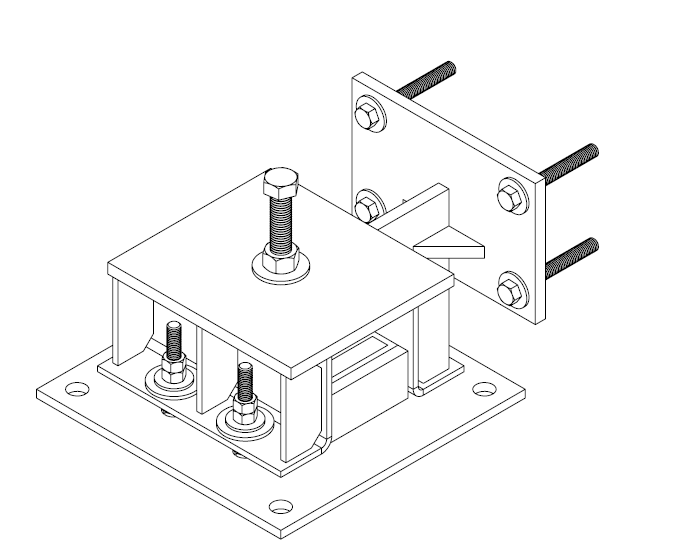
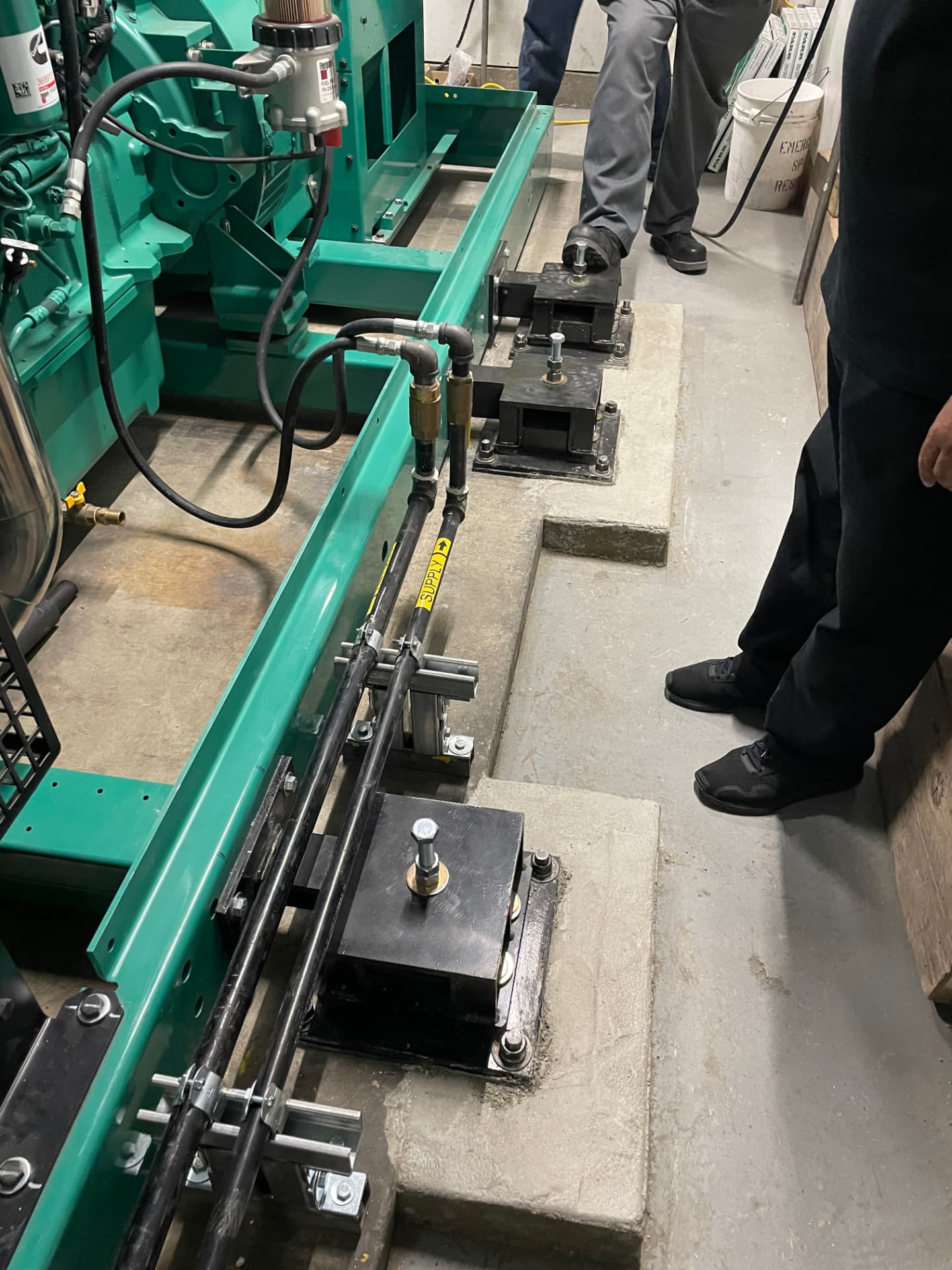
- An off-set support plate. A support plate attached to the sprung top portion engages the protected equipment laterally, at a position offset from the vertical axis of the unsprung bottom portion. The equipment sits beside the spring, not on top of it.
- Two rectangular guide assemblies. Each assembly uses a pair of parallel guide plates straddling a single bracing plate, with a rubber sleeve between them. They guide vertical motion of the sprung portion while restraining transverse and longitudinal seismic demand.
- Four guide bolts with travel-limiting nuts. Guide bolts fixed to the bottom plate pass through the L-shaped sides of the sprung assembly; paired nuts tightened against each other set a hard limit on vertical travel — bounding lift-off and re-impact by design rather than by field adjustment.
- A pre-load bolt. A bolt threaded into the top portion bears against the spring so the mount can be pre-loaded to its design deflection before the equipment weight is released onto it.
Why it matters in the calculation
Because the restraint is part of the isolator housing, the assembly behaves as a housed restrained mount:
- No open-spring classification — the isolator is not relying on an external snubber to develop lateral capacity.
- No loose air gap between equipment and snubber, so the §13.6.4 impact amplification for gapped restraints doesn't get triggered.
- One anchorage load path to design per ACI 318-19 Chapter 17 — the isolator base to the slab or housekeeping pad — instead of two (isolator base plus snubber bracket).
- Vertical travel is a known number from the nut setting, so the up-acting seismic load on the spring is a design quantity, not a field surprise.
Where the height saving pays off
- Rooftop mechanical units on existing curbs with no room to raise the unit.
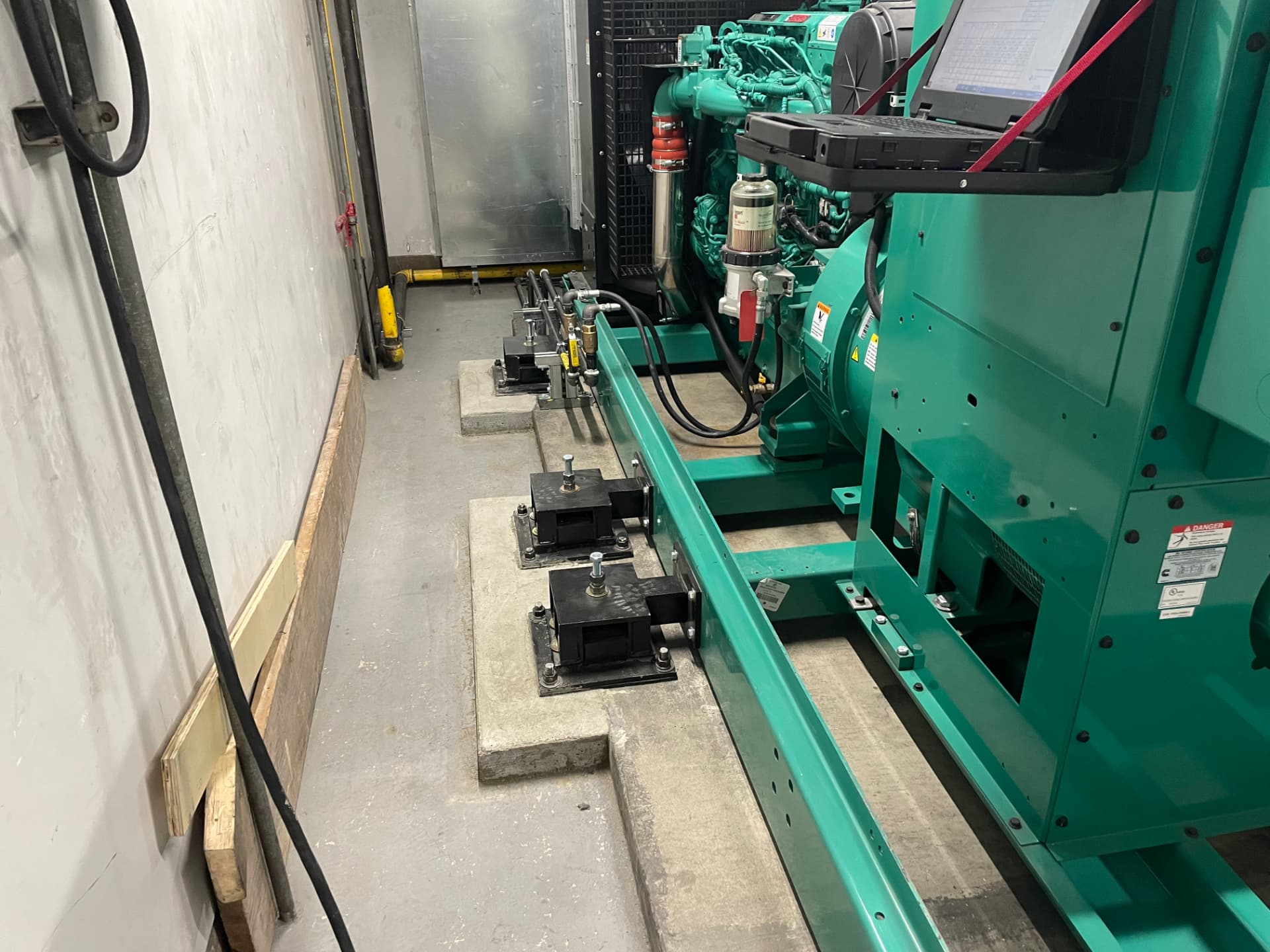
- Generators in walk-in enclosures where the skid elevation is fixed by the exhaust and fuel connections.
- Data center equipment with strict clearance envelopes above and below the frame.
- Hospital mechanical rooms where ceiling height, ductwork and Ip = 1.5 restraint all compete for the same inches.
Qualification and submittals
The production isolators built on this design have been independently shake-table tested to ICC-ES AC-156 acceptance criteria. We deliver PE-stamped vibration isolator calculations and anchorage calculations alongside the hardware, so the isolator, its restraint and its anchors clear IBC/CBC and HCAI/OSHPD review as one package.
More detail
Full patent details, claim summary and specification data are on the patented off-set seismic mount page. For selection help on a clearance-constrained project, contact us with equipment weights, mounting points and available headroom.